


Curriculum Vitae
Thio Teddy
Email: teddy_pelitadua@yahoo.com
EDUCATION
August 2005 – Present. College student at the London School of Public Relations Jakarta, Public Relations Concentration
July 2002 – June 2005. Pelita II High School
July 1999 – June 2002. Pelita II Junior High School
July 1993 – June 1999. Dharma Suci Elementary
WORK EXPERIENCES
June 2007 – present. English Grammatical Teacher in
July 2005 – present. English Conversational Teacher in Pelita II
July 2006 – June 2007. English Grammatical Teacher in
ACHIEVEMENT
2001. 1st Position Mr Pelita Contest
2001. 2nd Scrabble team “Damai Cup”
2001. 1st Spelling Contest “
2002. 1st Position Speech contest “Pelita II Cup”
2004. 2nd Position Debating Contest “
2005. Rootseeking Summer Camp in
OTHER SKILLS
2004. EF Conversation Course
ORGANIZATIONAL EXPERIENCE
OSIS Member for
2003. Best participants “Jambore Tunas Mahasiswa” HIKMAHBUDDHI
2004 – 2005. Leader for “Komisi Remaja Ekayana”
2007. Candidat of Coordinator for “PMVEG – Komisi Remaja Division
INTERESTS
I like to play Billiard
I love sports such as; football, basketball, swimming
I’m expert in Guitar and Piano
I’m curious and always find out something from Internet’s browsing
PERSONAL DETAILS
Address : Jl. Karya Barat 3 / 3
Telephone No. : (021) – 5660661
Phone No. : 08998873805
POB :
DOB : 4th October 1987
Status : Engage
Shio : Rabbit
Element : Fire
Sign : Libra
Religion : Buddha
REFERENCES
Mrs. Gissele, BA. Comm
Dean of The Department of Business Studies
Campus A
Wisma Darmala Sakti - Annexe
Jl. Jendral Sudirman Kav. 32
(021) – 5708143
campusa@lspr.edu


From the depths of our heart we want to be happy all the time, but we are not usually very concerned with the happiness and freedom of others. In reality, however, our own happiness and suffering are insignificant compared to that of other living beings. Others are countless, whereas we ourself are just one single person. Understanding this, we must learn to cherish others and accomplish the ultimate, supreme goal of human life.
Of all worldly possessions the most precious is said to be the legendary wish-granting jewel. It is impossible to find such a jewel in these degenerate times, but in the past, when human beings had abundant merit, there used to be magical jewels that had the power to grant wishes. These jewels, however, could only fulfil wishes for contaminated happiness – they could never bestow the pure happiness that comes from a pure mind. Furthermore, a wish-granting jewel only had the power to grant wishes in one life – it could not protect its owner in his or her future lives. Thus, ultimately even a wish-granting jewel is deceptive.
The only thing that will never deceive us is the attainment of full enlightenment. What is enlightenment? It is omniscient wisdom free from all mistaken appearances. A person who possesses this wisdom is an enlightened being. According to Buddhism, ‘enlightened being’ and ‘Buddha’ are synonymous. With the exception of enlightened beings, all beings experience mistaken appearances all the time, day and night, even during sleep.


One way to gain an understanding of past and future lives is to examine the process of sleeping, dreaming, and waking, because this closely resembles the process of death, intermediate state, and rebirth. When we fall asleep, our gross inner winds gather and dissolve inwards, and our mind becomes progressively more and more subtle until it transforms into the very subtle mind of the clear light of sleep. While the clear light of sleep is manifest, we experience deep sleep, and to others we resemble a dead person. When the clear light of sleep ends, our mind becomes gradually more and more gross and we pass through the various levels of the dream state. Finally, our normal powers of memory and mental control are restored and we wake up. When this happens, our dream world disappears and we perceive the world of the waking state.
A very similar process occurs when we die. As we die, our winds dissolve inwards and our mind becomes progressively more and more subtle until the very subtle mind of the clear light of death becomes manifest. The experience of the clear light of death is very similar to the experience of deep sleep. After the clear light of death has ceased, we experience the stages of the intermediate state, or bardo in Tibetan, which is a dream-like state that occurs between death and rebirth. After a few days or weeks, the intermediate state ends and we take rebirth. Just as when we wake from sleep, the dream world disappears and we perceive the world of the waking state, so when we take rebirth the appearances of the intermediate state cease and we perceive the world of our next life.
The only significant difference between the process of sleeping, dreaming, and waking and the process of death, intermediate state, and rebirth is that after the clear light of sleep has ceased, the relationship between our mind and our present body remains intact, whereas after the clear light of death this relationship is broken. By contemplating this, we will gain conviction in the existence of past and future lives.


In reality most of our emotional problems are nothing more than a failure to accept things as they are – in which case it is patient acceptance, rather than attempting to change externals, that is the solution. For example, many of our relationship problems arise because we do not accept our partner as he or she is. In these cases the solution is not to change our partner into what we would like him to be, but to accept him fully as he is. There are many levels of acceptance. Perhaps we already try to tolerate our partner’s idiosyncrasies, refrain from criticizing him or her, and go along with his wishes most of the time; but have we in the depths of our heart given up judging him? Are we completely free from resentment and blaming? Is there not still a subtle thought that he ought to be different from the way he is? True patience involves letting go of all these thoughts.
Once we fully accept other people as they are without the slightest judgement or reservation – as all the enlightened beings accept us – then there is no basis for problems in our relations with others. Problems do not exist outside our mind, so when we stop seeing other people as problems they stop being problems. The person who is a problem to a non-accepting mind does not exist in the calm, clear space of patient acceptance.
Patient acceptance not only helps us, it also helps those with whom we are patient. Being accepted feels very different to being judged. When someone feels judged they automatically become tight and defensive, but when they feel accepted they can relax, and this allows their good qualities to come to the surface. Patience always solves our inner problems, but often it solves problems between people as well.


| |||
The Mindfulness of Meditation technique is a simple meditation procedure that can create a deep state of relaxation in your mind and body. As the mind quiets down but remains awake you will experience deeper, more silent levels of awareness.
1. Start by sitting comfortably in a quiet place where you will have a minimum amount of disturbance.
2. Close your eyes.
3. Breath normally and naturally, gently allowing your awareness to be on your breathing. Simply observe your breath, trying not to control it or alter it in a conscious way.
4. As you observe your breath, you may notice that it changes of its own accord. It may vary in speed, rhythm, or depth, and there may even be occasions when your breath seems to stop for a time. Whatever happens with your breathing, innocently observe it without trying to cause or initiate changes.
5. You will find that at times your attention drifts away from your breath and you are thinking about other things or listening to noises outside. Whenever you notice you are not observing your breath, gently bring your attention back to your breathing.
6. If, during the meditation, you notice that you are focusing on some feeling, mood or expectation, treat this as you would any other thought and gently bring your attention back to your breathing.
7. Practice this meditation technique for fifteen minutes.
8. At the end of fifteen minutes, keep your eyes closed and just sit easily for two or three minutes. Allow yourself to come out of meditation gradually before opening your eyes and resuming your activity.
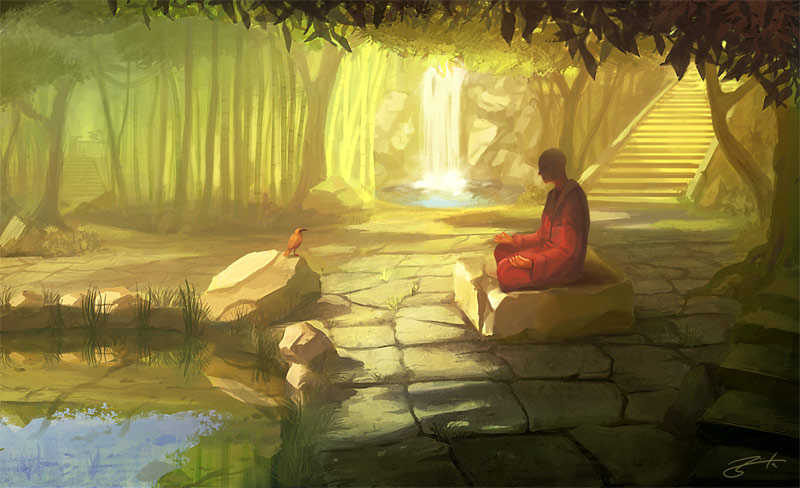
To do no evil;
To cultivate good;
To purify one's mind:
This is the teaching of the Buddhas.
--The Dhammapada

The Four Noble Truths
2. Suffering is due to attachment;
3. Attachment can be overcome;
1. Suffering is perhaps the most common translation for the Sanskrit word duhkha, which can also be translated as imperfect, stressful, or filled with anguish.
Contributing to the anguish is anitya -- the fact that all things are impermanent, including living things like ourselves.
Furthermore, there is the concept of anatman -- literally, "no soul". Anatman means that all things are interconnected and interdependent, so that no thing -- including ourselves -- has a separate existence.
2. Attachment is a common translation for the word trishna, which literally means thirst and is also translated as desire, clinging, greed, craving, or lust. Because we and the world are imperfect, impermanent, and not separate, we are forever "clinging" to things, each other, and ourselves, in a mistaken effort at permanence.
Besides trishna, there is dvesha, which means avoidance or hatred. Hatred is its own kind of clinging.
And finally there is avidya, ignorance or the refusal to see. Not fully understanding the impermanence of things is what leads us to cling in the first place.
3. Perhaps the most misunderstood term in Buddhism is the one which refers to the overcoming of attachment: nirvana. It literally means "blowing out," but is often thought to refer to either a Buddhist heaven or complete nothingness. Actually, it refers to the letting go of clinging, hatred, and ignorance, and the full acceptance of imperfection, impermanence, and interconnectedness.
4. And then there is the path, called dharma. Buddha called it the middle way, which is understood as meaning the middle way between such competing philosophies as materialism and idealism, or hedonism and asceticism. This path, this middle way, is elaborated as the eightfold path.

The Eightfold Path
1. Right view is the true understanding of the four noble truths.
These two are referred to as prajña, or wisdom.
3. Right speech involves abstaining from lying, gossiping, or hurtful talk.
4. Right action involves abstaining from hurtful behaviors, such as killing, stealing, and careless sex.
These three are refered to as shila, or morality.
6. Right effort is a matter of exerting oneself in regards to the content of one's mind: Bad qualities should be abandoned and prevented from arising again; Good qualities should be enacted and nurtured.
7. Right mindfulness is the focusing of one's attention on one's body, feelings, thoughts, and consciousness in such a way as to overcome craving, hatred, and ignorance.
The last three are known as samadhi, or meditation.
A mental hospital was critically overcrowded. The doctor decides to get all the patients seated in one large room to conduct a test to see how many they discharge that day.
At the front of the room the Doctors took some chalk and drew a full size door on a Blackboard and offered an ice cream to any patient who could open the door.
There was a mad rush for the door with the patients scratching and clawing at the door and the handle.
The doctors were disappointed, until they noticed a single patient who remained in his chair and was quietly chuckling to himself as he watched his fellow patients.
Encouraged that at least one patient could be discharged today, the doctors asked him why he wasn't trying to open the door.
The patient, who could no longer contain his laughter, shouted, "I've got the key!"

1)
2)
3) Ramsin Yuseb ( terroris yang menyerang twin tower pada 1993 )
memiliki 11 huruf.
4) George W Bush memiliki 11 huruf.
5) Twin tower membentuk angka 11.
Mungkin itu sebuah kebetulan, tetapi
coba lihat :
1)
2) Pesawat pertama yang menabrak
3) Pesawat itu mengangkut 92 penumpang,9+2 = 11.
4) Pesawat 1 lagi yang menabrak
5) Tragedi itu terjadi pada 11 September, 9/11, 9+1+1 = 11
6) Tanggalnya sama dengan pelayanan darurat Amerika yaitu 911, 9+1+1 = 11.
Masih kebetulan? baca ini lagi :
1) Kejadian ini adalah kecelakaan pesawat ke 254, 2+5+4 = 11.
2) September 11 adalah hari ke 254 dlm tahun itu, 2+5+4 = 11.
3) Pemboman Madrid terjadi pada tgl 3/11/2004, 3+1+1+2+4 = 11.
Masih kebetulan, Nah sekarang adalah bukti yang paling mantap :
The most recognized symbol for the
"For it is written that a son of
still more rejoiced: for the wrath of the Eagle cleansed the lands of Allah and there was peace."
That verse is number 9.11 of the Quran.
Masih tidak percaya? Silakan coba yang ini, akan membuat bulumu berdiri :
Buka Microsoft Word dan lakukan seperti yang dibawah :
1. Ketik Q33 NY, ini adalah nomor penerbangan pesawat pertama yang menabrak
2. Highlight/Terangkan Q33 NY.
3. Ganti ukuran Font menjadi 48.
4. Ganti jenis Font menjadi WINGDINGS 1
APA YANG KAMU LIHAT ????


